Track the barrage
Watch the space above the knight and identify where incoming arrows will land.
Prototype snapshot · First Unity project
An endless survival game where a swift-footed knight must dodge an increasingly relentless barrage of falling arrows.
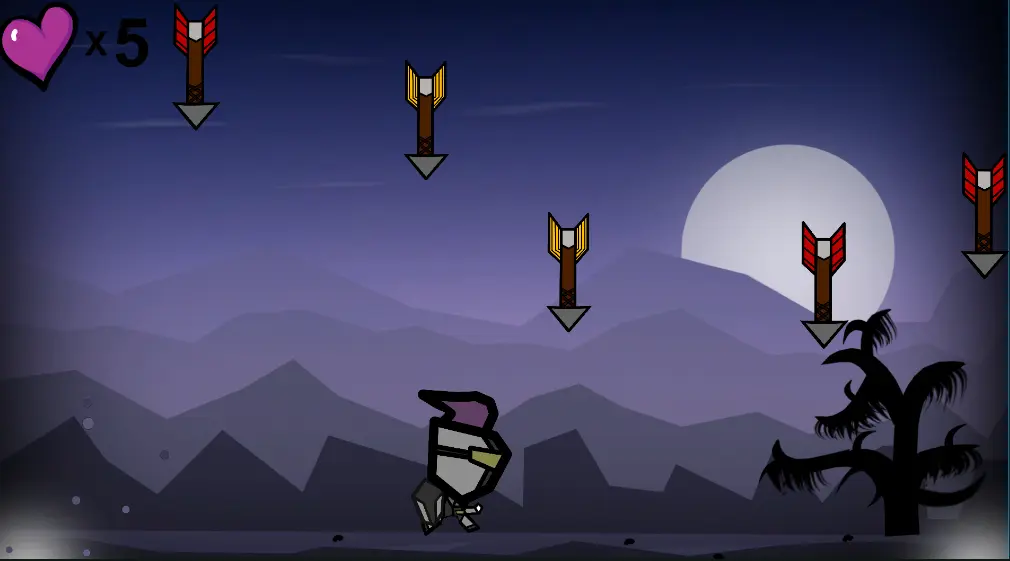
Overview
Descending Darts was the first game project I completed in Unity. The player moves along a constrained battlefield while arrows descend from above. Survival is intentionally impossible, shifting the goal from reaching an ending to improving how long each attempt lasts.
Its compact scope gave me a practical setting for learning how input, physics, animation, collision, game state, and visual feedback combine into a complete playable loop.
Gameplay loop
A small control set keeps the challenge centered on recognizing danger and committing to the right escape direction.
Watch the space above the knight and identify where incoming arrows will land.
Move left or right to create space before the safest route closes.
Use the dash to escape immediate danger when ordinary movement is not enough.
Continue adapting as the barrage tests reaction speed and positioning.
Development
The project began with guided Unity coursework and developed into an extended exercise in adjusting the game until its movement and presentation matched my own goals.
I repeatedly revised the knight and overall presentation as my visual understanding improved.
Tuning movement and the dash showed how timing and animation affect perceived responsiveness.
Falling hazards turned Unity’s physics and collision systems into immediate, visible gameplay feedback.
Takeaway
Descending Darts taught me that even a mechanically simple game requires many systems to work together reliably. Finishing it gave me the confidence to move from structured instruction toward more ambitious independent projects.
It now serves as a useful starting point in my portfolio: a clear record of where my Unity development began and how far the scope and architecture of my later work have progressed.